The Core Competence of the Hydraulic Breakers
In various crushing operations such as mining, construction, and road demolition, the impact force of the hydraulic breaker directly determines the efficiency of the operation. A hydraulic breaker with strong impact force can crush harder materials in a shorter time, significantly reducing fuel consumption and labor costs.
However, many equipment operators and owners have misconceptions about “how to truly enhance the impact force of the hydraulic breaker”, often blindly increasing the pressure but causing equipment damage. This article will, based on the working principle of của hthủy lực breaker, systematically explain the three core factors affecting the impact force and provide scientific and safe optimization methods to help you unleash the true potential of the equipment.
Working Principle of the Impact Hthủy lực Breaker
Hammer and Chisel
To understand how to enhance the impact force, one must first grasp the fundamental working principle of the impact hammer. The working mechanism of the hydraulic impact hammer can be compared to an ancient tool combination: a hammer and a chisel. Humans use hammers to strike the tail of the chisel, and the tip of the chisel transfers the concentrated force to the rock, achieving fragmentation.
Mechanization upgrade
The hydraulic breaker fully automates this process. The piston acts as the “hammer”, and the drill rod acts as the “chisel”. The hydraulic power provided by the excavator drives the piston to move back and forth rapidly inside the cylinder. The front end of the piston repeatedly strikes the tail of the drill rod, and the tip of the drill rod transmits the huge impact force to the object being crushed.
Therefore, the most fundamental conclusion is that the impact force of the breaker directly depends on the instantaneous impact energy when the piston collides with the drill rod. The greater the mass of the piston and the higher the speed at the moment of impact, the greater the kinetic energy (E = 1/2 mv²) it carries, and the stronger the impact force transferred to the drill rod. So, how can we make the piston hit harder? The following three dimensions are the key.
Dimension One
Optimize the hydraulic system of the carrier, simultaneous increase in pressure and flow rate. The hydraulic breaker operates “passively”, and all its energy comes from the hydraulic system of the carrier (such as an excavator or loader). Therefore, optimizing the hydraulic output of the main unit is the most direct way to enhance the impact force.
Increase hydraulic pressure: Enhance the “explosive force” of the piston
The piston moves within the cylinder and is driven by hydraulic oil. According to the principle of physics, thrust = pressure × area. When the cross-sectional area of the piston remains constant, increasing the pressure of the hydraulic system can directly increase the thrust acting on the piston.
- Mechanism of action: Higher pressure enables the piston to obtain stronger acceleration force during both the return stroke and the stroke phase. Especially during the stroke phase, the higher oil pressure means that the piston can impact the drill rod at a higher speed.
- Key operation points: This can be achieved by adjusting the main relief valve pressure set in the hydraulic system of the excavator for the hydraulic breaker However, it is necessary to strictly follow the maximum working pressure specified in the hydraulic breakertechnical manual (for example, adjusting the pressure from 150 bar to 170 bar). Blind overpressure will instantly damage the piston, the cylinder body, and even the main pump of the excavator.
- Notes: Pressure increase must be carried out within the design margin of the equipment and the temperature rise of the hydraulic oil should be observed to prevent the system from overheating.
Increase hydraulic flow: Enhance the “impact frequency” of the piston
If pressure determines “how much force”, then flow rate (the volume of oil flowing through per unit time) determines “how fast”. The speed of the piston’s movement is directly related to the flow rate of the hydraulic oil entering the cylinder.
- Mechanism of action: Increasing the supply flow rate can shorten the time required for the piston to complete a full reciprocating stroke. This not only directly increases the strike frequency (number of strikes per minute, BPM), but also, the faster piston movement speed itself means an increase in kinetic energy during a single impact.
- Key operation points: Adjust or regulate the throttle valve in the crushing pipeline using the excavator monitor to set the flow rate within the recommended range for the impact hydraulic breaker(for example, from 80 liters/minute to 100 liters/minute).
- Notes: Excessive flow rate may cause the piston to move too fast, resulting in reversing before completing the full stroke, causing “empty strikes” or internal cavitation; too low flow rate will result in a decrease in frequency and reduced impact force.
Dimension Two
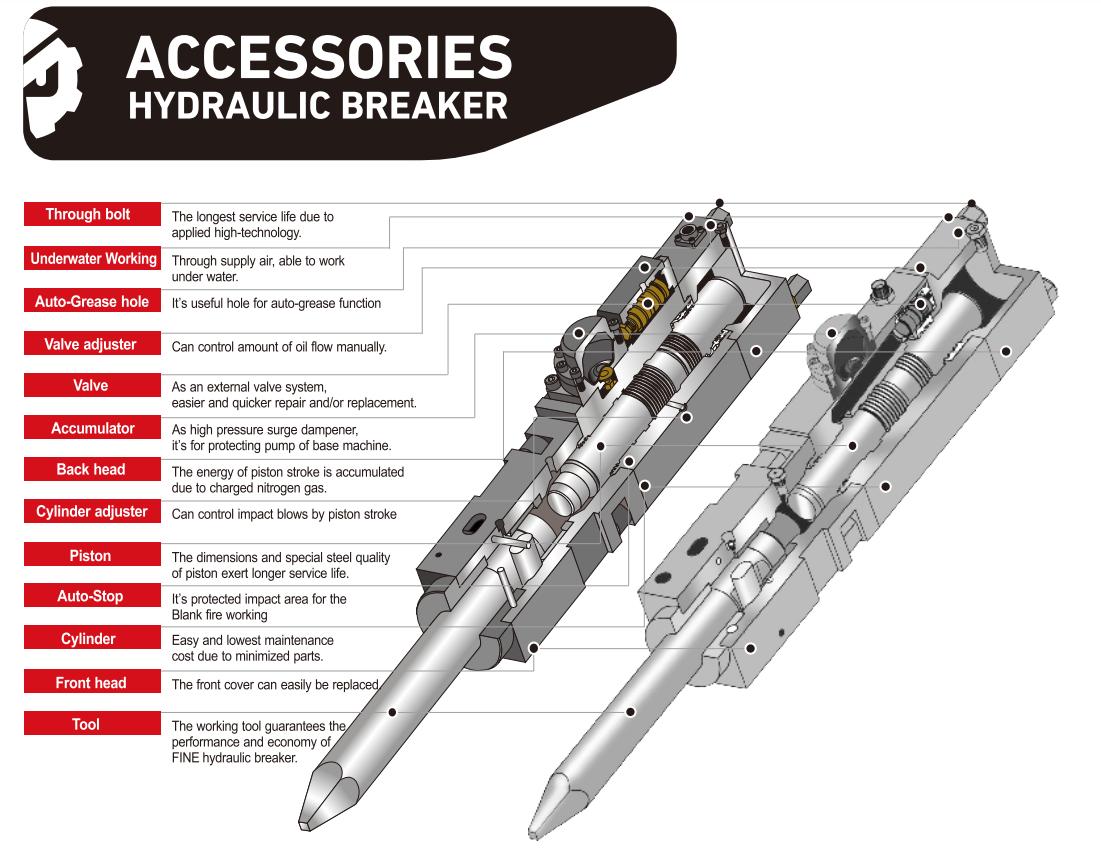
Scientifically adjusting nitrogen pressure, balancing energy storage and release. The nitrogen gas inside the rear cylinder (nitrogen chamber) of the breaker plays the role of an “gaseous spring”, being the core for energy amplification and buffering. Adjusting the nitrogen pressure is an effective way to regulate the impact characteristics.
Positive correlation between nitrogen pressure and impact force
- Energy Storage: When the piston moves back upwards, its rear end enters the rear cylinder and compresses the nitrogen gas. The higher the nitrogen pressure, the greater the stored compressive potential energy.
- Energy Release: When the reversing valve is switched, the piston begins its downward stroke. The compressed nitrogen gas instantly expands and acts together with the hydraulic oil on the rear end of the piston, generating a powerful “boosting force”. Therefore, within a reasonable range, appropriately increasing the nitrogen pressure in the rear cylinder can significantly enhance the explosive force of a single strike.
Key Warning
The nitrogen pressure should not be set too high. This is the most error-prone and destructive misconception during the adjustment process. There is an optimal range for nitrogen pressure, rather than it being able to be continuously increased indefinitely.
Excessive hazards
- Failure to operate normally. If the nitrogen pressure is too high, the piston will encounter a huge gas resistance during its return stroke. When the hydraulic oil pressure is insufficient to push the piston to the predetermined reversing position, the reversing valve cannot be triggered, and the piston will not complete the stroke, resulting in the impactor being “smothered” or stopping working.
- Component damage. Even if it manages to operate, excessive nitrogen pressure will generate peak impacts beyond the design limit when the piston collides with the drill rod, causing severe structural damages such as cracking of the piston end face, depression of the drill rod tail, and fatigue cracks in the cylinder body.
Scientific adjustment
The nitrogen pressure for filling must strictly follow the standard values specified in the hydraulic breaker technical manual (for example, the HB series is usually ≤ 10 kg/cm², and the SB series is approximately 15 kg/cm²). It should be filled according to the actual working conditions and fine-tuned, rather than pursuing the limit.
Dimension Three
Enhancing internal precision, the decisive role of manufacturing techniques. If the first two dimensions represent “acquired adjustments”, then the manufacturing precision of the product itself is the “innate genetic factor”. This aspect is determined by the technical and quality control capabilities of the crusher manufacturer.
Precise coordination to reduce energy loss
The core moving part inside the impact hydraulic breaker – the piston and the middle cylinder – has a precise clearance fit.
- Energy loss:If the clearance is too large, the high-pressure hydraulic oil will leak out through the gap (internal leakage), resulting in a decrease in the effective pressure and flow used to push the piston, and energy is wasted in vain.
- The value of precision manufacturing: Global top brands such as Decker (FRD), Belite (Montabert), Edie (Indeco), and Toku, etc., are able to maintain strong impact force. The key lies in their extremely high processing accuracy. Through equipment like CNC grinders, the mating tolerance between the piston and the cylinder is controlled at the micron level, minimizing internal leakage and ensuring that the hydraulic energy is efficiently converted into impact kinetic energy.
Oil Circuit Design and System Matching
In addition to the accuracy of the fit, the design of the internal oil passage also directly affects the efficiency of energy transmission.
- Optimizing the oil passage: The scientifically designed internal channels can reduce flow resistance, avoid bottlenecks, and allow the hydraulic oil to smoothly drive the piston. Some high-end brands also improve the response speed of the directional valve to make energy switching faster and with less loss.
- Overall efficiency: Excellent manufacturing techniques and design can achieve an energy conversion rate of over 95%, enabling the same hydraulic input to generate a stronger impact output.
Achieve Powerful Impact Mộtt Một Reasonable Cost
After understanding the above principles, you will have a clear criterion for choosing a hydraulic breaker. Our METDEEM hydraulic breaker is precisely developed and manufactured based on a profound understanding of the essence of impact force.
- Technology Integration: We have drawn on and integrated the core technical concepts of internationally renowned brands such as Decker and Belite, and implemented strict material selection and precise processing techniques for key components such as pistons, cylinder blocks, and directional valves.
- Precision Manufacturing: Through high-precision CNC equipment, we ensure a tight fit between components, effectively reducing the loss of internal pressure and flow, and achieving energy conversion efficiency comparable to that of international brands.
- Stable Performance: While ensuring strong impact force and high-frequency operation stability, we have optimized the production cost control system, enabling the METDEEM hydraulic breakerto provide you with a usage experience comparable to that of major brands at a more affordable price.
- Value for Money: For users who seek efficient operations but have limited budgets, METDEEM offers a reliable choice that combines high performance and high economy. You can enjoy a substantial improvement in impact force without having to pay for brand premiums.
Kết luận
Increasing the impact force of the impactor is not a simple “brute force” approach. It requires a systematic thinking: using the hydraulic pressure of the main unit as the “source”, the scientific nitrogen pressure as the “auxiliary”, and the precise manufacturing of the product as the “foundation”. Only when these three elements are optimized collaboratively and operate within their respective safety boundaries, can the maximum potential of the impactor be safely, persistently and efficiently released.
If you are looking for a powerful, reliable, and cost-efficient hydraulic breaker, METDEEM is ready to support your operations. Our breakers are engineered with high-precision manufacturing, optimized hydraulic design, and durable materials to ensure strong impact force and stable performance.
Contact the METDEEM team today to learn more about our hydraulic breaker solutions, request technical specifications, or get professional advice on selecting the right model for your equipment and working conditions. Let METDEEM help you achieve higher efficiency and lower operating costs in your crushing operations.
Câu hỏi thường gặp
Q: If I directly set the pressure of the excavator to the maximum, will the impact of the hthủy lực breaker be stronger?
A: No, it will be much more likely to damage the equipment. The pressure must be strictly controlled within the maximum working pressure specified in the hydraulic breaker’s technical manual. Exceeding this pressure will cause the piston and cylinder to be damaged instantly.
Q: How can I determine if the nitrogen pressure of my impactor is too high?
A: If the impact force is weak when starting the impactor, the frequency is significantly reduced, or the piston seems to be “stuck” and unable to move, you should first check if the nitrogen pressure is too high, which is causing the piston to be blocked during its return stroke.
Q: Which one is more effective in increasing the impact force – increasing the hydraulic flow or increasing the pressure?
A: Both are complementary. Pressure mainly enhances the “explosive force” of a single impact, while flow mainly increases the “frequency” and the speed of the piston. The best result is achieved when both are operating within the recommended ranges and working together.
Q: Why is manufacturing accuracy said to affect the impact force?
A: Insufficient accuracy will result in excessive clearance between the piston and the cylinder, causing high-pressure oil to leak out, reducing the actual pressure used to push the piston and wasting energy, thereby resulting in a decrease in impact force.