Comprendre la compaction du sol dans la construction
Le compactage du sol joue un rôle clé dans les tâches de tranchée et de préparation du site. Cependant, cela provoque souvent des problèmes dans les travaux d'infrastructure souterraine. Les problèmes de compaction du sol apparaissent beaucoup lors des étapes de tranchée et de remplissage. Ces problèmes proviennent généralement d'une mauvaise séparation des matériaux, de mauvaises méthodes de remplissage ou de mélange dans des débris indésirables.
Lorsque le compactage s'avère faible, il nuit à la résistance globale des structures. Cela peut faire couler le sol, déplacer les tuyaux ou même laisser place aux bâtiments. Les répercussions financières de ces défaillances sont considérables, notamment les coûts de fouilles à nouveau, le remplacement de pièces, le ralentissement du projet et la création de risques de sécurité. Identifier les principales causes de ces problèmes de compactage aide immédiatement à maintenir la construction solide et réduit les corrections supplémentaires.
Le rôle des accessoires d'excavateur dans la préparation du site
Aujourd'hui’ s accessoires pour excavatrice ont changé la façon dont les constructeurs gèrent les tâches de tranchée et de compactage. Ces outils spéciaux augmentent la vitesse tout en améliorant la précision et la fiabilité des travaux sur le site.
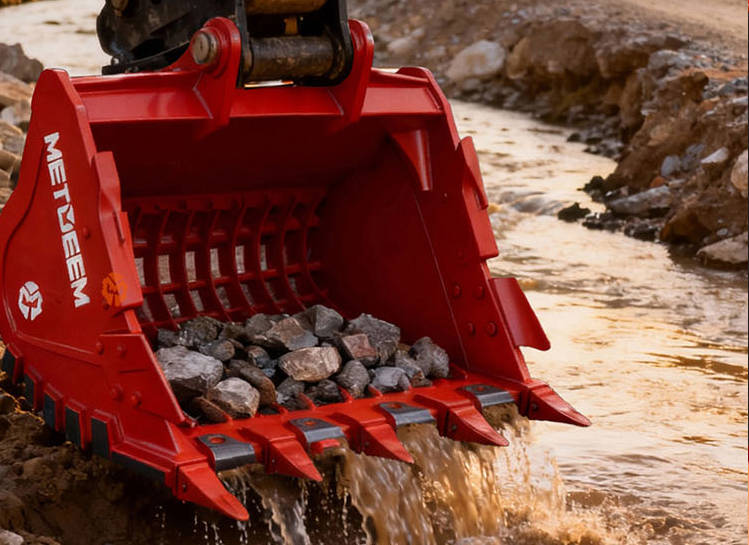
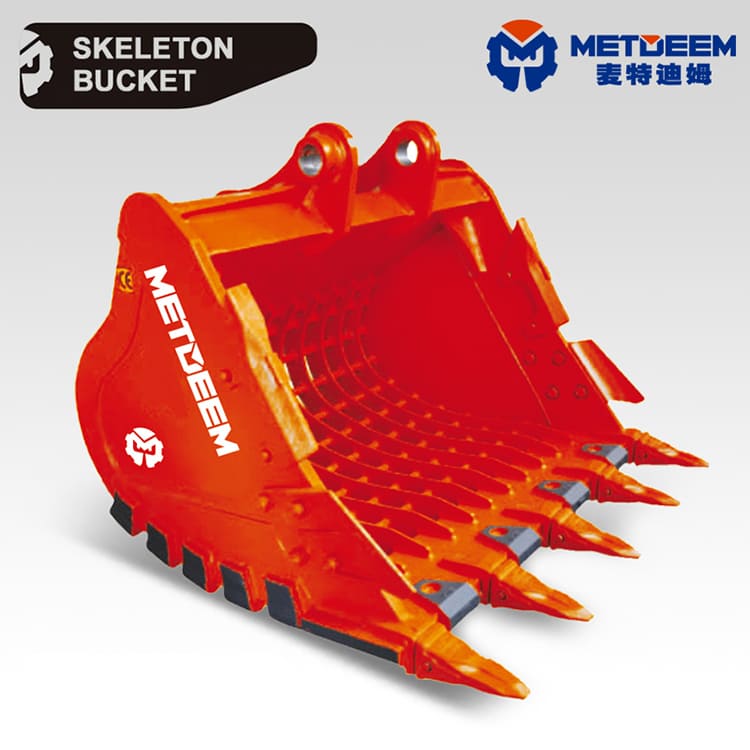
Un accessoire d’excavateur largement adopté pour la séparation de matériaux lors de la tranchée est le seau squelette de METDEEM (également connu sous le nom de seau grille). Il manipule le creusement et le tri des matériaux en même temps. Cette fonctionnalité intégrée s'avère très utile pour garder le sol libre de grands débris qui peuvent ruiner même le compactage si laissés dans le sol. Le principal avantage du seau de grille provient de sa fonction intelligente de synchronisation de creusement et de filtrage.
Défis de compaction du sol dans les tranchées
Causes des problèmes de compaction du sol
Quelques facteurs principaux conduisent à un mauvais compactage du sol:
- Les grands débris, tels que les roches ou les racines, dans le remplissage laissent des poches d'air qui rendent le sol moins robuste.
- Un mauvais tri du sol creusé pendant les fouilles entraîne des couches inégales, ce qui nuit à la densité finale.
- Les machines lourdes qui roulent sur la zone empaquetent certaines taches plus que d'autres, ce qui entraîne une force de soutien irrégulière.
Impact sur la qualité et le coût du projet
Ces problèmes touchent les installations de tranchée dur:
- Les zones à compaction inégale s'installent à des taux différents au fil du temps, de sorte que les travailleurs doivent creuser et les remplir.
- Des choses comme des tuyaux ou des routes construites dans des tranchées tremblantes échouent trop tôt.
- Chaque correction ajoute des dépenses, de plus d'heures de travail et de carburant pour porter sur l'équipement et les retards dans la fin du travail.
Comment METDEEM Skeleton Bucket aborde ces problèmes
Séparation précoce des matériaux surdimensionnés
La configuration de la grille dans ce seau éloigne le sol fin des mélanges rugueux tels que la saleté, les pierres et les débris de construction. Il le fait bien en creusant. Ainsi, le seau squelette METDEEM fournit un matériau plus propre pour le remplissage. Cela réduit les lacunes dans le sol et aide à réaliser un compactage stable. La sortie triée reste plus pure, ce qui convient bien pour des travaux respectueux de l'environnement comme le nettoyage des lits de rivières ou le tri des ordures dans les zones de construction.
Améliorer la stabilité des tranchées dès le début
Le seau squelettique soutient des tranchées stables en permettant de creuser soigneusement avec une perturbation minimale du matériel:
- Il récupère et soulève le matériel aussi rapidement qu'un seau régulier, et il trie la charge en remontant sans effort supplémentaire.
- Nettoyer les côtés de la tranchée réduit le risque que les murs se creusent lors de la mise en place de tuyaux ou de formes.
- Des piles bien rangées de matériaux creusés facilitent la décision de réutiliser le sol ou d'enlever immédiatement les déchets.
Réduire le retravail et les coûts opérationnels
En commençant par un remplissage de qualité supérieure, il y a moins de pannes après le compactage:
- Il combine le creusement, le chargement et le tri en une seule étape en douceur, manipulant tout en une seule passe.
- Les travailleurs sautent des outils de tri supplémentaires ou des tâches de sélection manuelle.
- Les inspecteurs approuvent les travaux plus rapidement parce que le remboursement répond aux normes dès le début.
Avantages par rapport à d'autres accessoires d'excavateur
Squelette seau vs seau de broyage
Les seaux de broyage décomposent principalement les matériaux en tailles plus petites, mais ils ne’ t costume maintenir le remplissage en bonne forme. Les seaux de squelette trient sans changer la composition naturelle du sol. Cette approche fonctionne mieux pour maintenir les bonnes tailles de particules nécessaires pour un compactage uniforme à travers la tranchée.
Par exemple, dans les travaux sur des terrains rocheux, le broyage peut transformer le sol en poussière qui se compacte mal sous charge, tandis que le tri du seau squelettique maintient le mélange équilibré pour un soutien à long terme.
Skeleton Bucket vs Buckets à usage général
Les seaux standard manquent le tri intégré à ceux spécialisés. Ils laissent de gros morceaux finir par se mélanger avec les piles de sol. Le seau de squelette de METDEEM saute ces mouvements supplémentaires en fusionnant creusement et tri en une seule action facile.
Optimiser l'efficacité du dépistage avec les fonctionnalités de conception METDEEM
Éléments structurels clés du seau squelettique METDEEM
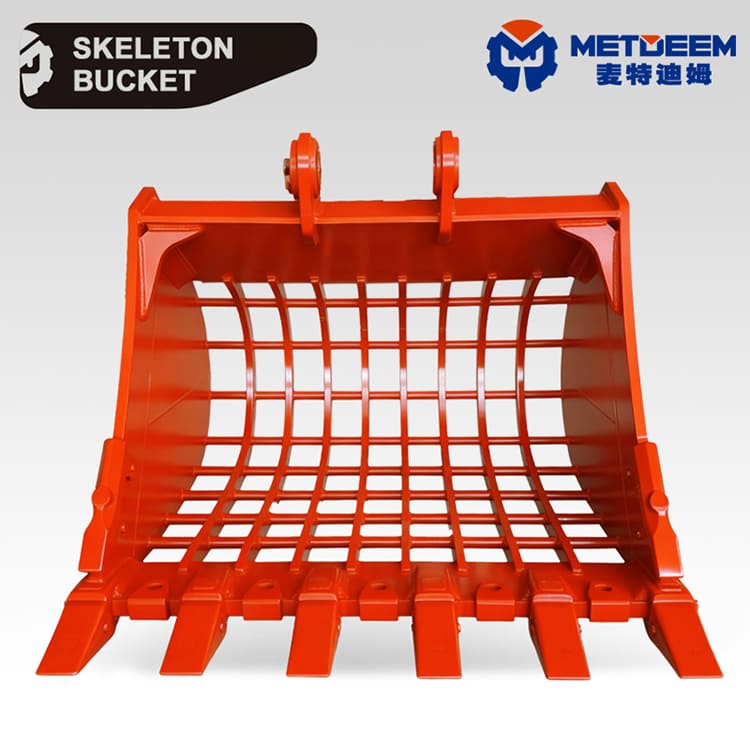
Le DM06 seau squelette utilise une construction difficile pour les sites de travail difficiles. Son cadre provient de tôles d'acier fortes, et les points vitaux ont des plaques coulées et des blocs qui résistent à l'usure. Les utilisateurs peuvent ajuster les espaces de grille pour s'adapter au travail, comme 30 à 50 mm pour les travaux fluviaux ou 80 à 120 mm pour le tri des débris de construction. Cette personnalisation brille dans des paramètres variés.
Compatibilité avec diverses conditions du site
Les constructeurs l’ont conçu pour s’adapter aux différents besoins de creusement :
- Il s'adapte à des domaines tels que les travaux urbains, l'agriculture, la gestion des forêts, les projets d'eau et le mouvement de terrain de base.
- L'outil gère la saleté humide, le gravier rugueux ou les remplissements mélangés sans problème.
- Il se connecte aux configurations d'excavatrices courantes, de sorte qu'il s'insère dans la plupart des gammes de machines sans tracas.
Meilleures pratiques pour l'utilisation de seaux de squelette dans les projets de tranchée
Intégration du dépistage dans le flux de travail Trenching
Pour en tirer le meilleur parti :
- Commencez le tri dès que vous commencez à creuser pour éviter que le matériel sale se propage plus tard.
- Cela réduit la nécessité de commuter les engrenages ou de retravailler le sol, ce qui permet d'économiser du temps du travailleur, de la consommation de carburant et des coûts de machine.
- Remettez le bon sol filtré dans la tranchée immédiatement, ou éliminez les mauvaises choses sans délai.
Conseils d'entretien pour les performances à long terme
L'entretien simple le maintient fort :
- Vérifiez souvent les zones d'usure comme les barres, les bords de coupe et les joints.
- Éliminez régulièrement les fentes de la grille pour empêcher l'accumulation de bouchons.
- Gardez-le couvert au ralenti pour protéger la finition des intempéries difficiles ou des produits chimiques.
Conclusion
Les échecs dans le compactage du sol peuvent ruiner des plans de tranchée bien pensés. Le METDEEM Skeleton Bucket aborde ces problèmes directement là où ils commencent. Cette configuration s'éloigne de l'ancienne façon de creuser et de trier séparément. Au lieu de cela, il regroupe plusieurs tâches en un seul flux. Les entrepreneurs qui l'utilisent voient des tranchées plus fortes, moins de fixation plus tard et de réelles réductions des coûts quotidiens. Pour ceux qui cherchent à améliorer la préparation du site tout en réduisant les dangers, ce seau de squelette devient un outil incontournable.
FAQ (questions fréquentes)
Q: Comment le seau squelette empêche-t-il les problèmes de compaction du sol?
R: En dépistant les matériaux surdimensionnés pendant l'excavation, il assure un matériau de remplissage uniforme qui peut être compacté uniformement pendant le remplissage, réduisant le risque de dépôt ou de défaillance structurelle.
Q: Quel type de projet bénéficie le plus de l'utilisation d'un seau squelette?
R : Les projets impliquant des tranchées, le dragage fluvial, le tri des déchets de construction ou toute tâche nécessitant une séparation propre du sol des débris bénéficieront considérablement.
Q: L'utilisation d'un seau squelette permet-t-elle d'économiser des coûts sur place?
A : Absolument. Il réduit la commutation des équipements, minimise le tri manuel, réduit les retards d'inspection et réduit les coûts de carburant et de main-d'œuvre tout au long du cycle de vie du projet.