Choosing the right hydraulic breaker is a critical decision that can directly affect working efficiency, project costs, equipment reliability, and long-term profitability. With different breaker types, structures, and specifications available on the market, buyers need to consider more than just the initial purchase price. Excavator compatibility, working conditions, material hardness, maintenance requirements, and expected productivity all play an important role in the selection process. Before comparing the main types of hydraulic breakers and deciding which one is the best fit, let us first look at the common challenges and costly mistakes customers often encounter when choosing a product.
Pain points for foreign customers in product selection: Choosing the wrong hammer results in high costs.
For foreign contractors and mining operators, choosing the right breaker hammer is far more than just a matter of price. If the equipment selection is incorrect, subsequent situations may involve a series of chain reactions:
- The efficiency fails to meet expectations: The crushing speed is slow, the construction period is delayed, and the project cost overruns.
- The equipment is prematurely damaged: The crushing hammer does not match the excavator, resulting in hydraulic system failures or structural components cracking.
- The maintenance cost gets out of control: Spare parts are hard to find, maintenance is frequent, and downtime is lengthy.
- The hidden costs are huge: A seemingly inexpensive crushing hammer may, due to frequent failures and low efficiency, end up having a total cost much higher than that of a highquality product.
The mainstream crushing hammers currently available on the market can be mainly classified into two technical schools: Furukawa Series (HB series) and Soosan Series (SB series). These two series have fundamental differences in design concepts, impact characteristics, and applicable working conditions. Understanding these differences is the first step in making an accurate selection decision.
HB Series (Furukawa Technology): Highfrequency stability, longlasting option
The HB series is derived from the technology of Furukawa in Japan. Its naming convention usually ends with “XXG”, such as 05G, 10G, 20G, etc.
Structural Feature: External Directional Valve
The most distinctive feature of the HB series is the external placement of the directional valve the directional valve is an independent valve body that is installed outside the middle cylinder body.
Advantages: The middle cylinder structure is more complete and sturdy, with strong resistance to impact deformation. When the directional valve is repaired, there is no need to disassemble the entire middle cylinder, making maintenance very convenient.
Configuration: For each model of the HB series, an accumulator is standardly equipped. This not only enhances the impact force but also absorbs hydraulic pulses to protect the hydraulic system of the excavator.
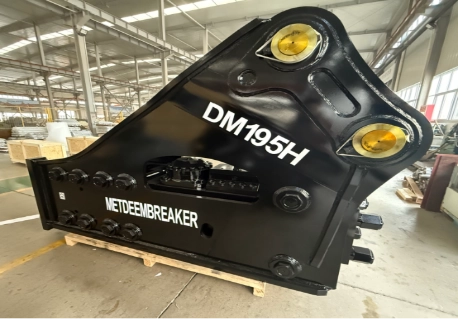
Working Principle: Low nitrogen content, high frequency
The HB series operates in a low nitrogen pressure mode, and the nitrogen pressure in the rear cylinder body is generally no more than 10 kg/cm².
- Impact Characteristics: The single impact force is relatively weak, but the frequency of impacts is high for example, in the case of HB20G, the impact frequency can reach 400800 bpm.
- Efficiency Logic: Efficiency is enhanced through continuous highfrequency impacts.
- Applicable Conditions
The HB series is suitable for materials with medium hardness or lower: sand and gravel, weathered rocks, asphalt pavement, demolition of reinforced concrete (nonthick layers), etc.
SB Series (Soosan Technology): Heavy Hammer Impact, Rock Resistant Champion
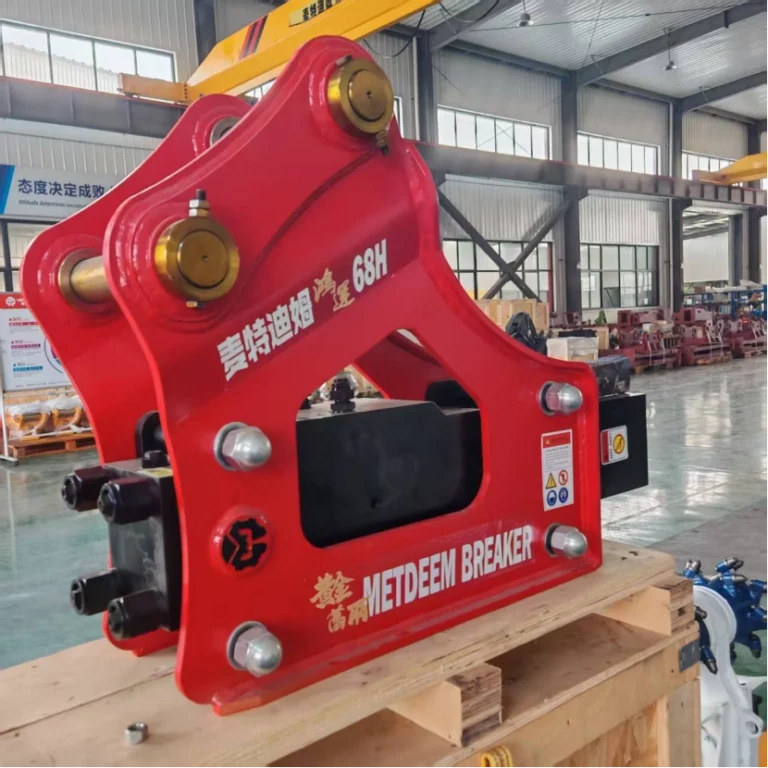
The SB series is derived from the Soosan technology from South Korea. The naming convention usually involves “SB” followed by a number or directly naming it based on the diameter of the drill rod, such as SB10, SB20, 45, 53, 68, etc.
Structural Feature: Internal Switchover Valve
The SB series adopts an inbuilt design for the directional valve,the directional valve is directly integrated into the middle cylinder body.
Advantages: Completely eliminates the joint surface between the valve body and the cylinder body, reducing the risk of oil leakage. The structure is more simple and compact.
Configuration: Most of the SB series impactors below model 140 do not come with an accumulator, while models above 140 are equipped with an accumulator as standard.
Working Principle: High Nitrogen Content, High Eruption
The SB series operates in a high nitrogen pressure mode. The nitrogen pressure varies significantly depending on the model.
| Model Specifications | Nitrogen Pressure Value |
| Small Model | Approximately 15 kg/cm² |
| Medium Model | 20 25 kg/cm² |
| Large Model | 25 35 kg/cm² |
- Impact Characteristics: The single impact has extremely high power, but the frequency is relatively low for example, in SB70, the impact frequency is 350600 bpm.
- Efficiency Logic: The single destructive force of “heavy hammer blow” is relied upon to enhance work efficiency.
- Applicable Conditions
The SB series is suitable for highhardness working conditions: raw mine rocks, metal mining, thicklayer concrete foundations, hard granite crushing, etc.
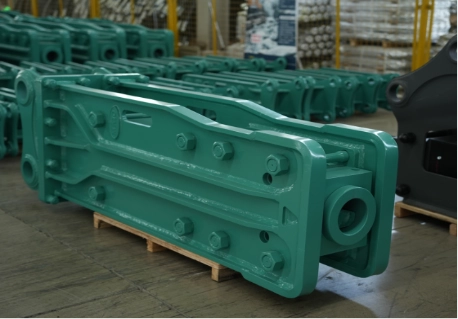
HB Series vs SB Series: Comprehensive Comparison
| Comparison Dimension | HB Series (Furukawa Technology) | SB Series (Soosan Technology) |
| Technology Source | Japan Furukawa | South Korea Soosan |
| Naming Method | XXG (e.g. 05G, 10G, 20G) | SB + Number or Shank Diameter |
| Direction Valve Position | External, separate valve body | Internal, integrated into middle cylinder body |
| Pressure Reducing Reservoir Configuration | Standard for all models | Most below 140 do not have it, standard for above 140 |
| Nitrogen Pressure | Low nitrogen (≤ 10 kg/cm²) | High nitrogen (15~35 kg/cm²) |
| Impact Characteristics | Low impact force, high frequency | High impact force, low frequency |
| Component Stress | Low impact peak, long component lifespan | High impact peak, high strength requirements |
| Manufacturing Cost | Complex structure, higher cost | Relatively simple structure, lower cost |
| Maintenance Method | Convenient for direction valve maintenance | Requires disassembly of cylinder for maintenance, more complex |
| Ideal Operating Conditions | Sandstone, weathered rock, mediumhard materials | Mining rocks, metal ores, thick concrete layers |
Selection Suggestions: Make decisions based on the working conditions
Choose the HB series if:
- The work objects are mainly composed of materials of medium hardness or lower (sand, weathered rocks, road surfaces)
- You aim for a longer component lifespan and lower longterm maintenance costs
- Frequent continuous operations are required, rather than single heavy impacts
Choose the SB series if:
- The work objects are mainly composed of hard materials (primary mine rocks, metal ores, thick layers of concrete)
- Strong singleshot explosive force is required to overcome hard materials
- The initial purchase budget is limited, and a relatively high component wear rate can be accepted
Conclusione
There is no single hydraulic breaker that is suitable for every application. The best choice depends on the hardness of the material, the required impact force and frequency, the excavator model, the working environment, and the long-term operating budget. The HB series is generally a better option for continuous, high-frequency work on medium-hard materials, offering stable performance, convenient maintenance, and a longer service life. In contrast, the SB series is more suitable for hard rock, mining, and heavy concrete demolition where powerful single-impact force is required. Buyers should therefore evaluate overall productivity, equipment compatibility, maintenance costs, and spare-parts availability instead of focusing only on the initial purchase price. A properly matched hydraulic breaker can improve efficiency, reduce downtime, protect the excavator’s hydraulic system, and deliver greater long-term value.
Domande frequentis
Domanda: Can the accessories of the HB series and the SB series be used interchangeably?
A: No. The piston structure, cylinder oil passage and internal dimensions of the two are completely different, and most of the components cannot be interchanged.
Domanda: Why is the HB series more expensive than the SB series?
A: The HB series adopts an external reversing valve structure, which has more components and higher precision requirements, resulting in a naturally higher manufacturing cost.
Domanda: The SB series below 140 does not have accumulators. Does this have any impact on the excavator?
A: There is a certain impact. The absence of accumulators means that hydraulic pulses cannot be effectively absorbed, and longterm use may accelerate the wear of the excavator’s hydraulic pump.