The Challenges of Traditional Kerbstone Installation
Traditional kerbstone installation remains a tough, hands-on job that usually calls for workers to lift stones by hand, line them up carefully, and set them in place. Such approaches create ongoing problems for city works and building sites alike.
High material waste due to manual handling stands out as a major headache. Lacking exact tools, kerbstones easily chip or break while moving them or putting them down. And each broken one piles onto the site’s total scrap, which drives up expenses and holds back the schedule. Another challenge is inefficient installation time impacting project timelines. Hands-on lining up and constant fixes drag out the work a great deal. So workers keep tweaking every stone’s spot to get even lines, and that eats up hours better used elsewhere in the build. Finally, increased costs from frequent kerbstone replacements puts extra strain on funds. If kerbstones crack in place or sit crooked from sloppy drops, they usually need swapping out or resetting. Both steps add avoidable bills to city jobs.
To solve these challenges, contractors and municipal engineering teams are increasingly turning to hydraulic kerbstone grapples for excavators. Tools like the METDEEM DM06 Kerbstone Grapple Rock Grabber allow operators to lift, rotate, and place kerbstones with precision, reducing breakage while dramatically improving installation efficiency.
Advantages of Using a Kerbstone Grapple
Reducing Material Waste with Precision Tools
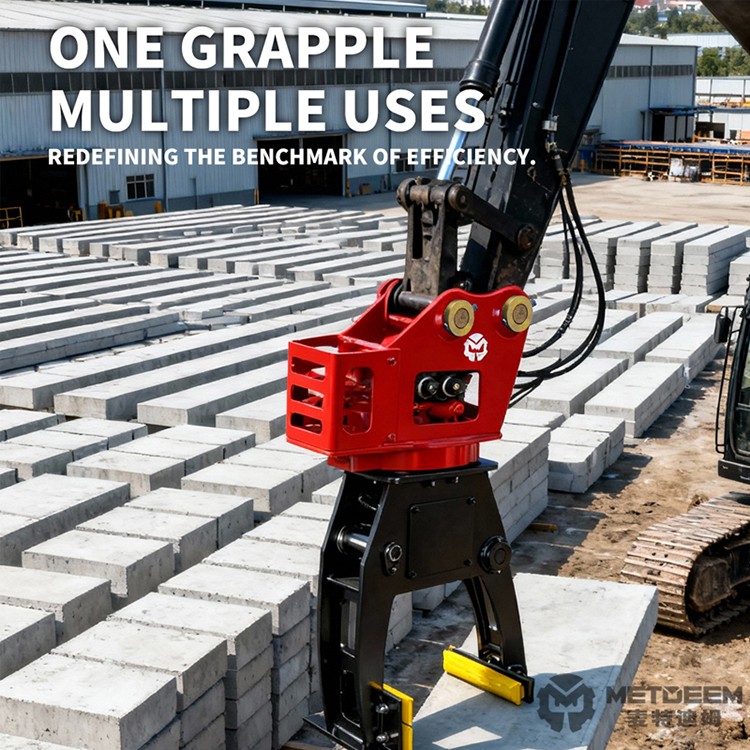
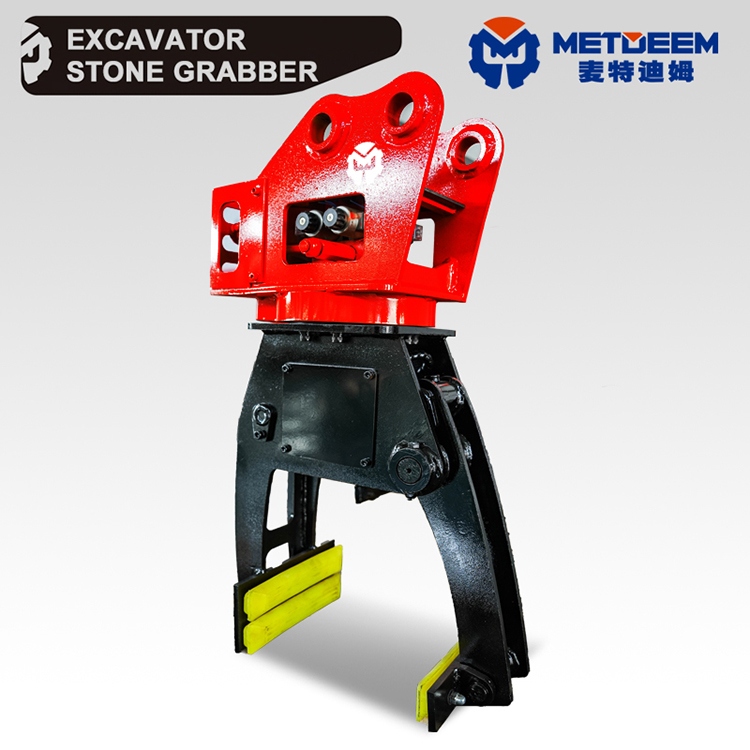
Current hydraulic attachments, such as the METDEEM DM06 Kerbstone Grapple Rock Grabber for CAT PC Excavator, have changed the way site managers deal with kerbstones. It is used for installing and transporting curb stones and is often applied in places such as roads, squares, and parks where rock installation is required. The tool holds each kerbstone firmly as it lifts, avoiding scrapes on the face or splits at the edges.
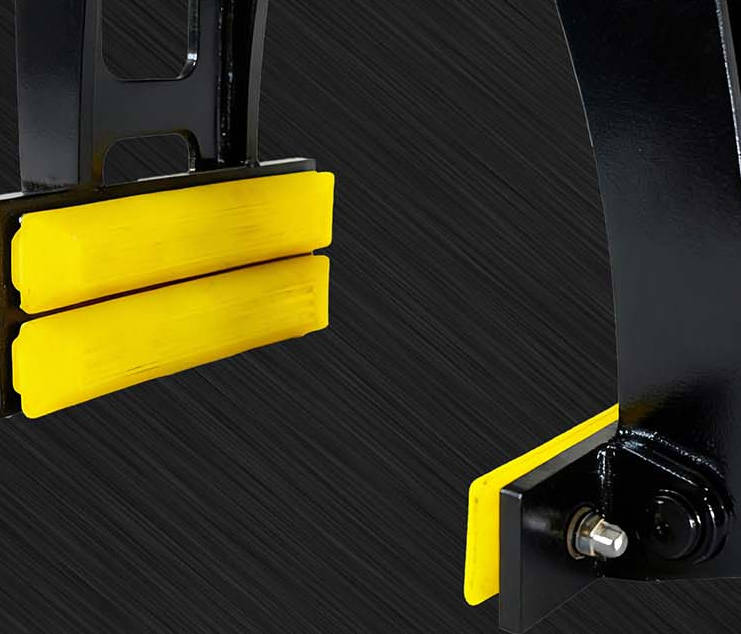
The grapple’s design includes rubber protection pads on its clamping arms. The clamping arm of the curbstone clamp is equipped with a buffer rubber pad to protect the curbstone from damage. This basic but solid addition cuts down on scrap during use. It does so by easing pressure at touch spots and stopping slides, which keeps every handled piece whole.
Moreover, precision control through hydraulic actuation allows operators to grip and release kerbstones smoothly. Driven by the hydraulic cylinder of the excavator, the two clamping arms equipped with rubber protective pads close in parallel to grip and hold the curbstone. And this kind of handling delivers steady results no matter the stone’s dimensions, which cuts down on swaps as projects go on.
Operators in parks often deal with varied shapes, from straight edges to curved ones. The parallel close ensures a firm hold without twisting, preserving details that manual grabs might mar.
Enhancing Installation Efficiency
The METDEEM DM06 Kerbstone Grapple builds in solid hydraulic grip features that boost output right on the job site. The rotary design model, through a high-performance rotary motor, can achieve bidirectional infinite rotation. So crews place each kerbstone right without shifting the excavator base, which saves hours and cuts fuel use.
The clamping plates are usually designed with an arc shape, allowing for adjustment to better fit the shape of the curbstone and enabling the clamping of curbstones of different sizes and shapes. Thus, it delivers spot-on placement down to the millimeter, even on rough terrain.
Additionally, METDEEM’s use of imported alloy steel components enhances durability while maintaining precise motion control under heavy workloads. The imported rotary motor is made of special alloy steel, providing powerful and stable hydraulic power. As a result, it speeds up each stone cycle, trimming overall lay time a lot versus old hand methods.
Collaboration with Thumb and Backfill Buckets
For comprehensive paving operations, METDEEM’s thumb clamps and bucket systems complement its grapples perfectly. It is used in conjunction with a bucket to pick up waste materials, scrap steel, etc. During curb installation projects, thumb clamps secure stones during transfer, while backfill buckets efficiently complete soil compaction afterward—creating a cohesive workflow from start to finish.
Consider a roadside job: the grapple sets the curb, then the thumb clamp grabs loose gravel for backfill, and the bucket packs it down tight. This chain cuts handling steps, reducing errors in uneven spots like sloped lots.
These combined systems not only enhance operational flexibility but also reduce mechanical wear by minimizing repetitive attachment changes throughout daily shifts.
Impact on Municipal Engineering Projects
Cost Savings in Labor and Materials
By automating previously manual tasks, municipalities can achieve substantial savings in both labor hours and material costs. Automated gripping mechanisms reduce human error while ensuring each stone remains intact during handling. The result is fewer damaged units requiring replacement—a direct reduction in procurement expenses.
Moreover, reduced manpower requirements translate into lower overall labor expenditures per project phase. With machines performing precision placement automatically through hydraulic control rather than manual alignment efforts, teams can complete larger sections within shorter working periods.
Improving Overall Project Timelines
Speed remains one of METDEEM’s strongest advantages in municipal engineering applications. The company’s hydraulic technology ensures smooth transitions between lifting, rotating, aligning, and releasing motions—all executed within seconds per cycle.
On a park lane install, cycles drop from five minutes to 45 seconds each, letting teams finish 100 meters in three days flat. The fluid moves steadily, even in wet or crowded conditions.
Operators can easily complete multi-directional and precise grasping and placement in the cab. This capability eliminates repeated repositioning common in traditional setups while maintaining perfect linear alignment along road edges or park pathways.
Conclusión
METDEEM continues advancing urban construction efficiency through innovation-driven attachment design. Our DM06 Kerbstone Grapple Rock Grabber exemplifies how precision engineering reduces material waste while accelerating installation cycles across diverse municipal projects worldwide. When paired with our complementary tools like thumb clamps or backfill buckets, contractors gain unmatched flexibility without compromising accuracy or safety standards.
Looking to reduce material waste and speed up kerbstone installation on your next project? The METDEEM DM06 Kerbstone Grapple is designed to help contractors achieve precise stone placement, lower labor costs, and faster project completion across road, park, and municipal engineering projects.
Contact METDEEM today to learn more about our kerbstone grapples and hydraulic attachments for excavators. Or request a product quote to see how our equipment can improve efficiency on your next infrastructure project.
Preguntas frecuentes
Q: How does a kerbstone grapple reduce material waste?
A: It provides precise hydraulic control that prevents chipping or cracking during lifting operations; rubber protection pads further safeguard surfaces against impact damage.
Q: How does METDEEM’s technology improve installation time?
A: Its high-performance rotary motor allows continuous 360-degree rotation for accurate stone positioning without moving the excavator base.
Q: Can these tools be used in other types of projects?
A: Yes—they integrate seamlessly into various municipal engineering tasks such as park landscaping or pavement restoration requiring precision handling.