How to Pick the Right Rock Grapple for Your Excavator
A rock grapple can turn an excavator into a practical tool for quarry work, demolition cleanup, stone placement, and recycling. Yet the largest or heaviest model is rarely the best choice. A poor match may reduce lifting ability, slow the hydraulic cycle, or place needless strain on pins and the dipper arm. The right choice begins with the carrier, then moves to the material and the daily task.
As contractors ask one machine to handle several tools, a clear specification sheet is more useful than a broad claim such as “fits a 20-ton machine.”
Start With the Excavator, Not the Grapple
The excavator sets the limits. Record the exact machine model, operating weight, stick configuration, lifting chart, and auxiliary hydraulic details before asking for a quotation. Machine tonnage is a useful filter, not a final answer. Two excavators in the same weight class may have different pin centres, bracket widths, hydraulic flow, and lifting capacity at reach.
Compare total attachment and load weight with the carrier’s lifting chart. Capacity changes with boom position and working radius, so a grapple suitable near the tracks may not suit long side reach.
Send the supplier these details:
- Exact excavator model and serial range
- Operating weight and stick length
- Pin diameter, pin-centre distance, and bracket width
- Quick-coupler model, if fitted
- Auxiliary flow and pressure
- Required rotation function
- Typical material and largest expected piece
Match the Grapple to the Material and Duty
Material decides the jaw form. Rock and broken concrete call for a reinforced structure and tines that can hold irregular pieces. Mixed demolition waste may need closer tine spacing so smaller fragments do not fall through. Large boulders need a wide opening, but opening width alone says little about grip at partial closure.
Duty is equally important. Occasional landscape placement is not the same as repeated quarry loading. Continuous handling brings more cycles, impact, and abrasive contact. A light sorting tool may work well with loose waste yet wear quickly on sharp stone. Tell the maker what the grapple will lift, how often it will cycle, and whether it will dig into a pile or only pick from the surface.
Selective demolition and material recovery have made controlled sorting more valuable. Grapples separate stone, concrete, timber, and scrap before transport, although results still depend on planning and operator skill.
Check Weight, Balance, and Working Reach
Attachment weight changes the machine’s balance before any rock is lifted. A heavier body may look more durable, but extra steel also consumes part of the carrier’s available capacity. Buyers should compare structural strength with mass rather than treating weight as proof of quality.
Use the lifting chart for the real position: front or side, close or extended. Irregular stone may shift inside the jaws, so keep a sensible operating margin.
Choose Tine Shape and Opening Carefully
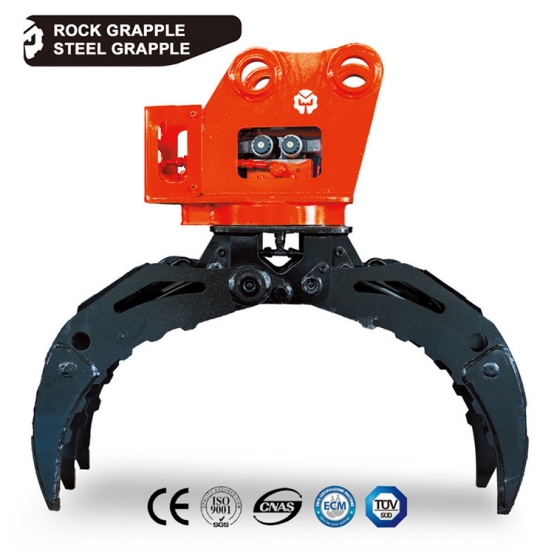
Tines create the contact that holds the load. Their profile, spacing, thickness, and closing path should suit the material rather than a catalogue photograph. Before comparing individual designs, buyers should describe the smallest and largest pieces that must be retained, along with the abrasion and impact likely during a normal shift. That description gives the maker a sound basis for selection.
Tine Spacing and Closure
Wide spacing lets soil and fine debris fall away, which is useful when sorting large stone. It can also release pieces that the crew intended to keep. Closer spacing holds mixed rubble more effectively but carries more material and may trap fines. Look at the jaws when nearly closed, not only at their maximum opening.
The tips should meet or overlap in a controlled path. Poor alignment concentrates force on one tine and weakens the hold. Ask for a drawing that shows the open and closed positions. Replaceable wear tips or protected edges can make service easier in abrasive work, provided replacements are available.
Opening Width and Jaw Depth
The maximum opening must accept the largest normal piece, with enough room for practical positioning. An oversized opening is not automatically better. A deep jaw may hold bulky material securely, while a shallow jaw can be easier to place around a flat slab. The closing force must remain useful through the working range, not only at one position.
Verify Pins, Brackets, Couplers, and Rotation
Physical fit must be confirmed from drawings. Check pin diameter, centre distance, ear width, boss thickness, and any coupler interface. A small error can prevent installation or create side play that quickly damages pins and bushes. Do not approve production from a machine photograph alone.
A quick coupler can shorten changes between a bucket, breaker, and excavator grapple attachment. It also adds weight and changes geometry. Confirm full movement without contact with the stick, hoses, or coupler body.
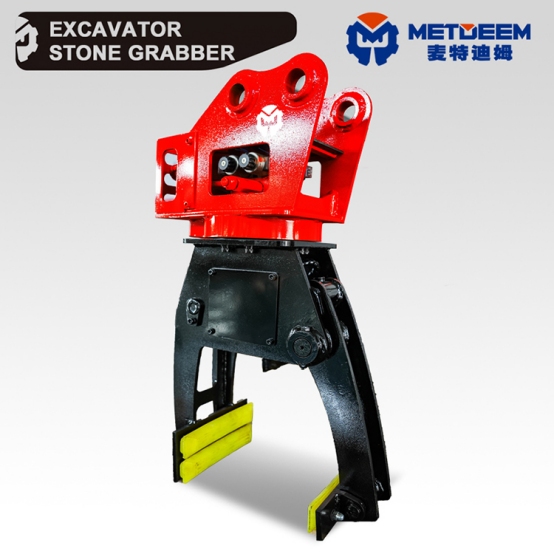
Rotation is useful for accurate stone placement and waste sorting. It requires another hydraulic function or a suitable control arrangement. Hose routing deserves close attention because a rotating head can pull, twist, or pinch a poorly placed line.
Match Hydraulic Flow and Pressure
A hydraulic rock grapple needs oil flow for movement and pressure for force. Both must fall within the attachment maker’s stated range. Too little flow gives slow cycles. Excess flow can make movement harsh and raise heat. Incorrect pressure may produce weak grip or overload seals and structural parts.
Check whether the grapple needs one circuit for opening and closing plus another for rotation. Ask about valve requirements, case drain needs, hose size, and connection type. The machine manual and attachment data should agree. Avoid choosing settings by trial when written limits are available.
Fast, abrupt movement makes accurate placement harder and sends shock through the attachment. Controlled movement matters around broken slabs and uneven boulders.
Inspect Wear Points and Service Access
Rock handling is abrasive. Examine tine tips, jaw pivots, pin bosses, bushes, cylinder mounts, hose guards, and weld transitions. These areas carry repeated load or contact the material. Grease points should be reachable when the attachment is mounted. Protected hoses are helpful, but covers should still allow inspection.
Ask which parts are replaceable and how they are identified. A lower purchase price loses its appeal if a simple bush or seal is difficult to obtain. For a used grapple, look for uneven tine wear, elongated pin holes, oil leakage, bent guards, cracked welds, and play in a rotating head.
Compare the Whole Attachment Plan
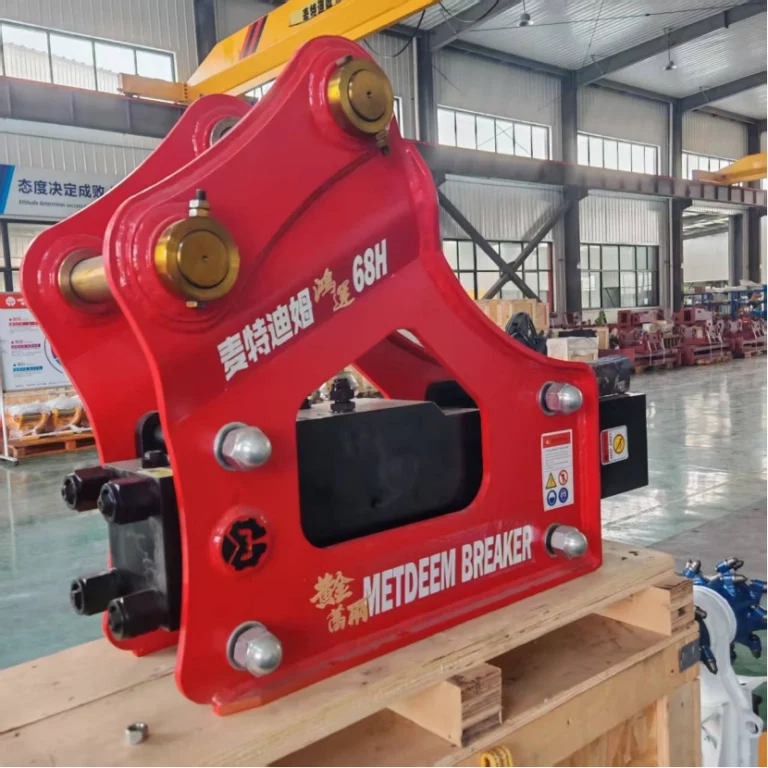
The grapple is only one part of an efficient work sequence. A contractor may use a hydraulic breaker to reduce large concrete, then switch to a grapple for sorting and loading. The carrier must be suitable for both tools, while the coupler and hydraulic lines must support safe changes.
At METDEEM, we manufacture construction machinery and parts for material handling, quarry, demolition, and related work. Buyers can review our construction machine range and compare it with the carrier already in their fleet. Our company profile explains our manufacturing and quality-control approach. We also use direct market contact, including the activity shown on our exhibition page, to hear how buyers use attachments in real jobs.
Before ordering, send complete machine data and describe the work in plain terms. Our existing grapple selection guidance can help form the first checklist, but the final match should always follow the relevant drawings and technical limits.
Conclusion
The right rock grapple for excavator work is the one that fits the carrier, holds the real material, and remains practical through a full working day. Begin with machine limits and mounting dimensions. Then compare attachment mass, tine spacing, jaw opening, hydraulic demand, coupler geometry, rotation, and service parts. Do not rely on tonnage or opening width alone. A detailed drawing and a complete hydraulic specification can prevent expensive changes after delivery. Buyers should also judge the grapple as part of the whole job sequence, especially where one excavator changes between breaking, sorting, and loading. A careful match gives the operator better control while protecting useful lifting capacity and reducing avoidable wear.
FAQs
Q: How many kilograms should a rock grapple weigh?
A: There is no universal kilogram figure; use the excavator lifting chart and the maker’s approved range.
Q: How many litres per minute does a hydraulic rock grapple need?
A: Required litres per minute vary by model. Match the grapple data sheet to the excavator circuit.
Q: Is a rotating rock grapple better for an excavator?
A: Rotation helps precise sorting and placement, but it adds kilograms, hydraulic demand, cost, and maintenance.