When it comes to hydraulic breaker hammers, selecting the right technology for your construction or mining equipment can significantly impact productivity, maintenance costs, and overall performance. The two leading technologies in the market today are the HB Series, represented by Japan’s Furukawa, known for its high-frequency stability and long lifespan, and the SB Series, represented by South Korea’s Soosan, recognized for its powerful burst impact ideal for tackling the toughest materials.
This guide provides a comprehensive comparison of the HB and SB series, delving into their core design features, performance characteristics, and the specific work conditions they excel in. Understanding these differences will help you choose the most suitable hydraulic breaker for your needs, ensuring maximum efficiency and reduced downtime. At METDEEM, our HB series and SB series breakers can meet the needs of different scenarios in the global market.
HB Series (Furukawa Technology): High-frequency Stability and Easy Maintenance
The technical essence of the HB series impact crushers stems from the Japanese construction machinery industry’s relentless pursuit of precision, reliability, and long lifespan. The core design concept is to reduce component loads through structural optimization, trading frequency for efficiency.
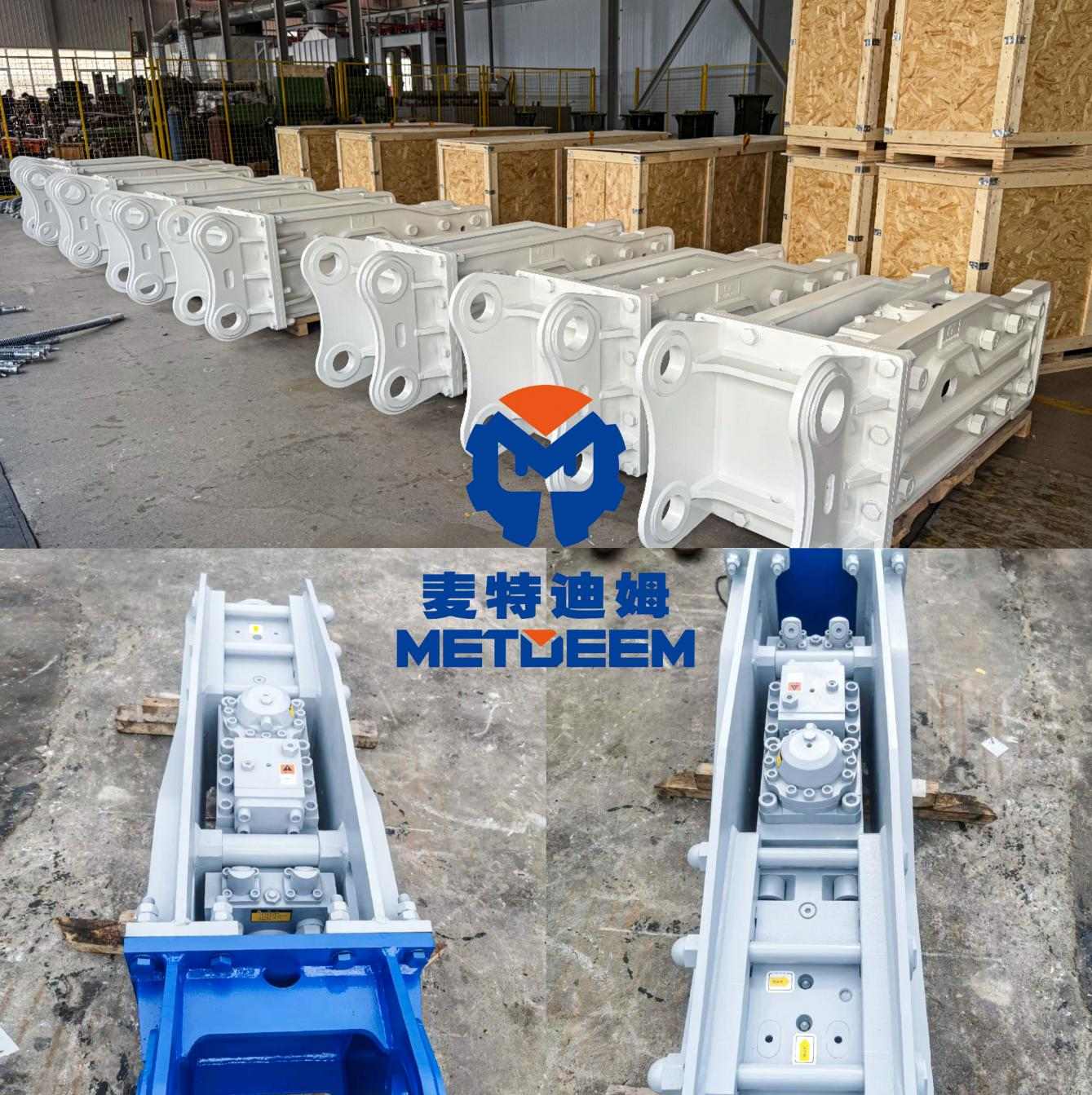
Structural Feature: External Directional Valve and Independent Valve Body
The most distinctive structural feature of the HB series is that its directional valve system is independent of the middle cylinder body.
- Design form: The directional valve is a separate valve body assembly, installed and fixed in the corresponding position of the middle cylinder body through precisely machined oil channels. This “external” design separates the valve body from the cylinder body physically.
- Structural advantages: Due to the independence of the valve body, the structure of the middle cylinder body is simplified, becoming a more robust and complete cylinder. This enhances the impact resistance and deformation resistance of the middle cylinder body and improves its structural stability.
- Maintenance convenience: When the directional valve needs to be repaired or replaced, the operator does not need to disassemble the entire middle cylinder body. They can directly remove the valve body from the outside for processing. This greatly simplifies the maintenance process, shortens the equipment downtime, and is extremely friendly for on-site maintenance.
Hydraulic and nitrogen system characteristics: Low-pressure high-speed mode
The HB series employs the technical approach of “low nitrogen pressure and high impact frequency.”
- Standard accumulator: Even for the smaller HB series crushers, accumulators are typically standard equipment. The role of the accumulator is crucial.
- Enhance impact force: Store energy during the piston’s return stroke and release it during the stroke, assisting in increasing the impact force.
- Protect the main unit: Effectively absorb the peak hydraulic pulse generated when the piston impacts, protecting the excavator’s main pump and hydraulic lines from damage caused by the impact.
- Low nitrogen pressure mode: The HB series is a typical low nitrogen pressure design. The nitrogen pressure of the rear cylinder body is usually set within a relatively low range of no more than 10 kg/cm². The lower nitrogen pressure means that the resistance during the piston’s return stroke is smaller, allowing the piston to be pushed back by the hydraulic oil more quickly, thus achieving a higher reciprocating motion speed.
Performance Characteristics and Application Scenarios
- Impact Characteristics: Due to the low nitrogen pressure, the potential energy stored by the piston during a single stroke is relatively small, resulting in a relatively weak single impact force. However, this comes at the cost of an extremely high impact frequency (number of impacts per minute, BPM). The HB series uses “high-frequency consecutive strikes” as the core means to enhance work efficiency.
- Component Stress and Lifespan: The lower impact force means that all stressed components, such as the piston, cylinder, and drill rod, are subjected to smaller peak instantaneous impact stress. This significantly reduces the fatigue damage rate of the components, resulting in lower failure rates for HB series products and longer lifespan of core components.
- Application Conditions: Its high-frequency, gentle but continuous impact characteristics are highly suitable for crushing materials of medium hardness and below, such as sand, weathered rock, asphalt pavement, and the demolition of reinforced concrete (non-thick layers). In these conditions, it can efficiently remove materials at a very fast pace while protecting the main unit and attachments.
SB Series (Soosan Technology): Powerful burst, rock-breaking champion
The SB series impact crushers are from South Korea. Their design philosophy focuses more on achieving a powerful single impact force to directly crush the hardest materials under extreme working conditions.
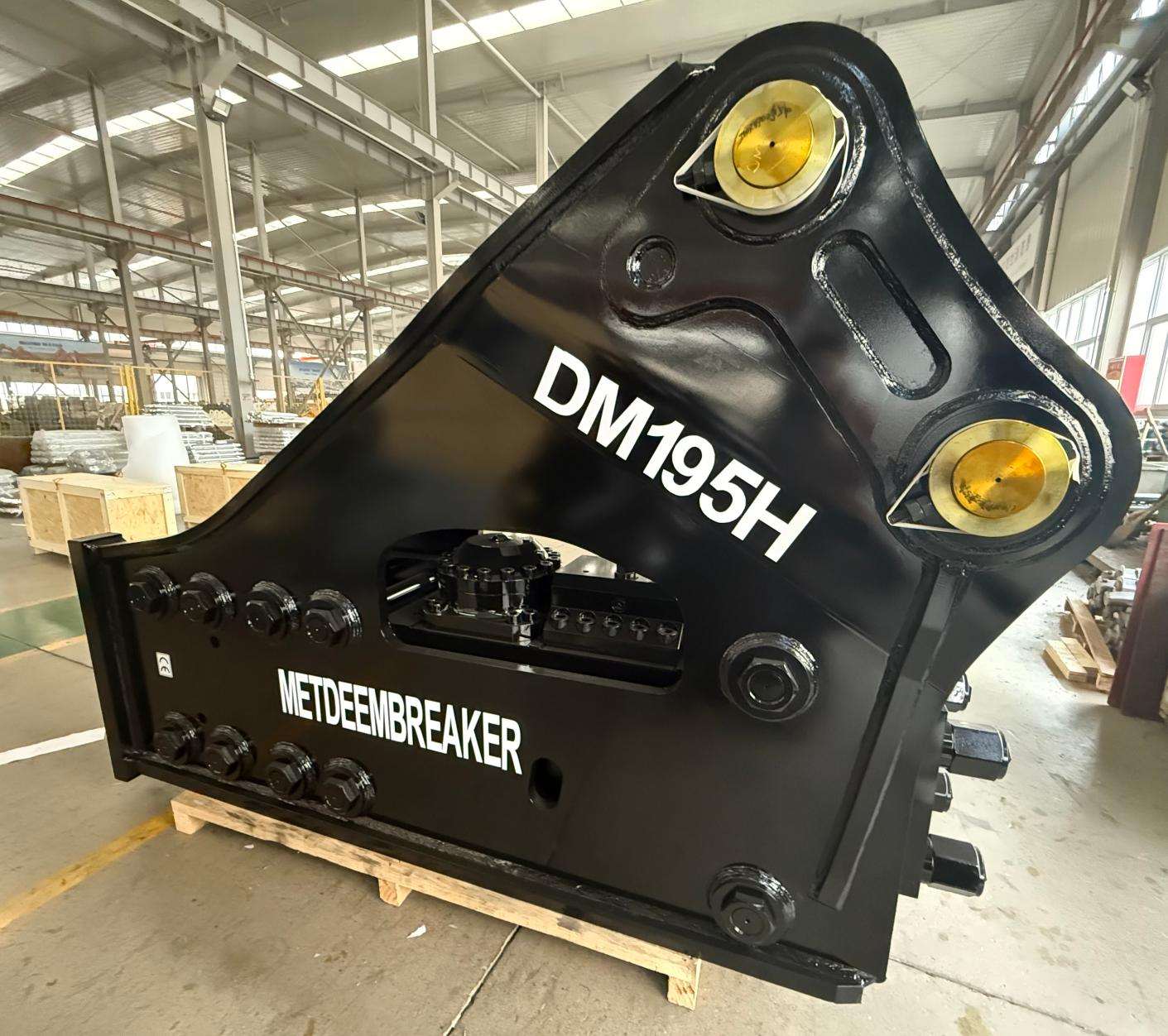
Structural Feature: Integrated internal displacement valve
The core feature of the SB series is that its directional valve is integrated within the middle cylinder body.
- Design form: The precision components, such as the valve core and valve sleeve of the directional valve, are directly installed in the valve holes pre-machined inside the middle cylinder body. The oil circuit switching is achieved through the oil passage of the cylinder body itself.
- Sealing advantage: This integrated design eliminates the connection surface between the valve body and the cylinder body, thereby physically eliminating the risk of oil leakage caused by the failure of the sealing at the joint surface. The entire hydraulic system is more concise and compact.
- Structural compactness: The internal directional valve makes the overall shape and sizeof the hammer more compact, and the weight distribution more concentrated.
Hydraulic and nitrogen system characteristics: High-pressure and high-energy mode
The SB series adopts the technical approach of “high nitrogen pressure and high explosive power”.
- Cylinder accumulator configuration: Some models of the SB series impactors (especially the medium and large-sized ones) are also equipped with accumulators, which are used to further enhance the impact efficiency and absorb shock.
- High nitrogen pressure mode: The SB series is a typical high nitrogen pressure design. The nitrogen pressure of the rear cylinder body is usually set at around 15 kg/cm² or higher. The high nitrogen pressure stores a huge amount of potential energy during the piston’s return stroke.
Performance Characteristics and Application Scenarios
- Strike Characteristics: During the stroke phase, the high-pressure nitrogen gas rapidly expands and works together with the hydraulic oil, providing the piston with an extremely high acceleration. This results in a very powerful single burst force and astonishing impact energy for the SB series. However, at the cost of this, its strike frequency is relatively lower than that of the HB series.
- Core Advantage: It uses “heavy hammer strikes” as the core method to enhance work efficiency. Each strike can cause deep fragmentation of hard materials.
- Applicable Conditions: The powerful burst force makes it the preferred choice for high-hardness conditions. Typical applications include: original mine rock crushing, metal mining, thick-layer concrete foundation demolition, and hard granite crushing. In these scenarios, the penetrating power and destructive force of a single strike are much more important than the frequency of low-frequency strikes.
Comprehensive Comparison and Selection Guide of Two Major Series
Having understood the technical differences between the two, the core basis for your choice will be your specific working conditions and cost considerations.
- In terms of the structure of the directional control valve:The HB series adopts an external independent valve body design, while the SB series integrates the valve body internally into the middle cylinder.
- In terms of the risk of oil leakage:The HB series has the possibility of oil leakage due to the contact surface, while the SB series has a relatively lower risk of oil leakage because it has no contact surface.
- In terms of the nitrogen pressure mode: The HB series uses a low nitrogen setting usually not exceeding 10 kg/cm², while the SB series has a high nitrogen mode pressure that can reach 15 kg/cm² or higher.
- In terms of the impact characteristics:The HB series shows a lower burst force but higher frequency, while the SB series has a higher burst force but a relatively lower frequency.
- In terms of the component stress:The HB series has a smaller impact peak, which is beneficial for extending the component lifespan, while the SB series has a larger impact peak, requiring higher component strength.
- In terms of cost:The HB series has a higher cost due to its complex structure, while the SB series has a relatively simpler structure and a lower cost.
- In terms of the maintenance method:The HB series directional control valve is easy to maintain, while the SB series requires more complex maintenance due to the valve body being integrated and the need to disassemble the cylinder.
- In terms of the ideal working conditions:The HB series is suitable for medium-hardness materials such as sand, weathered rock, and road surfaces, while the SB series is more suitable for high-hardness working conditions such as mine rocks, metal ores, and thick concrete layers.
Conclusion: There is no superiority or inferiority in technology; adaptability is the key
The HB series and the SB series represent two equally successful but distinctively different technical philosophies. The HB series, with its exquisite structural design, stable high-frequency output, and extremely long component lifespan, demonstrates excellent economic efficiency and reliability in medium-hard working conditions. The SB series, on the other hand, with its simple integrated structure and powerful single-burst force, has become a powerful tool for overcoming the hardest rocks.
Whether you’re working with medium-hard materials or need to crush the hardest rocks, making the right choice between the HB and SB series can make all the difference. Ready to optimize your equipment? Contact us today to find the perfect hydraulic breaker hammer for your specific needs and boost your operational efficiency.
FAQ
Q: Why are the HB series impact hammers less prone to failure?
A: Because they adopt a low nitrogen pressure design, the peak instantaneous impact stress that the components bear during impact is relatively small, and the fatigue damage rate is slow. Therefore, the failure rate is lower, and the lifespan is longer.
Q: Is the SB series breaker hammer suitable for road construction?
A: Yes, but its high explosive power characteristic is more suitable for extremely hard working conditions. Using it to break ordinary road surfaces might be overkill, and the fuel consumption would be relatively higher.
Q: Are the impact hammers of the external reversing valve more prone to oil leakage?
A: Theoretically, there is a risk of oil leakage at the interface between the valve body and the cylinder body. However, the sealing design of high-quality brands is very mature, and under normal use, the probability of oil leakage is extremely low. Moreover, its advantage in maintenance convenience is more prominent.
Q: How do I choose between the HB series and the SB series based on my excavator?
A: It mainly depends on the working conditions. If you are constantly crushing hard rocks, choose the SB series with greater power; if the working conditions are diverse and the main materials are of medium hardness, the HB series, which is more durable and cost-effective, is the better choice.
Q: What role does the accumulator play in the breaker hammer?
A: The accumulator stores energy during the piston’s return stroke, releases it during the stroke to enhance the impact force, and absorbs hydraulic shock to protect the main hydraulic system of the excavator.